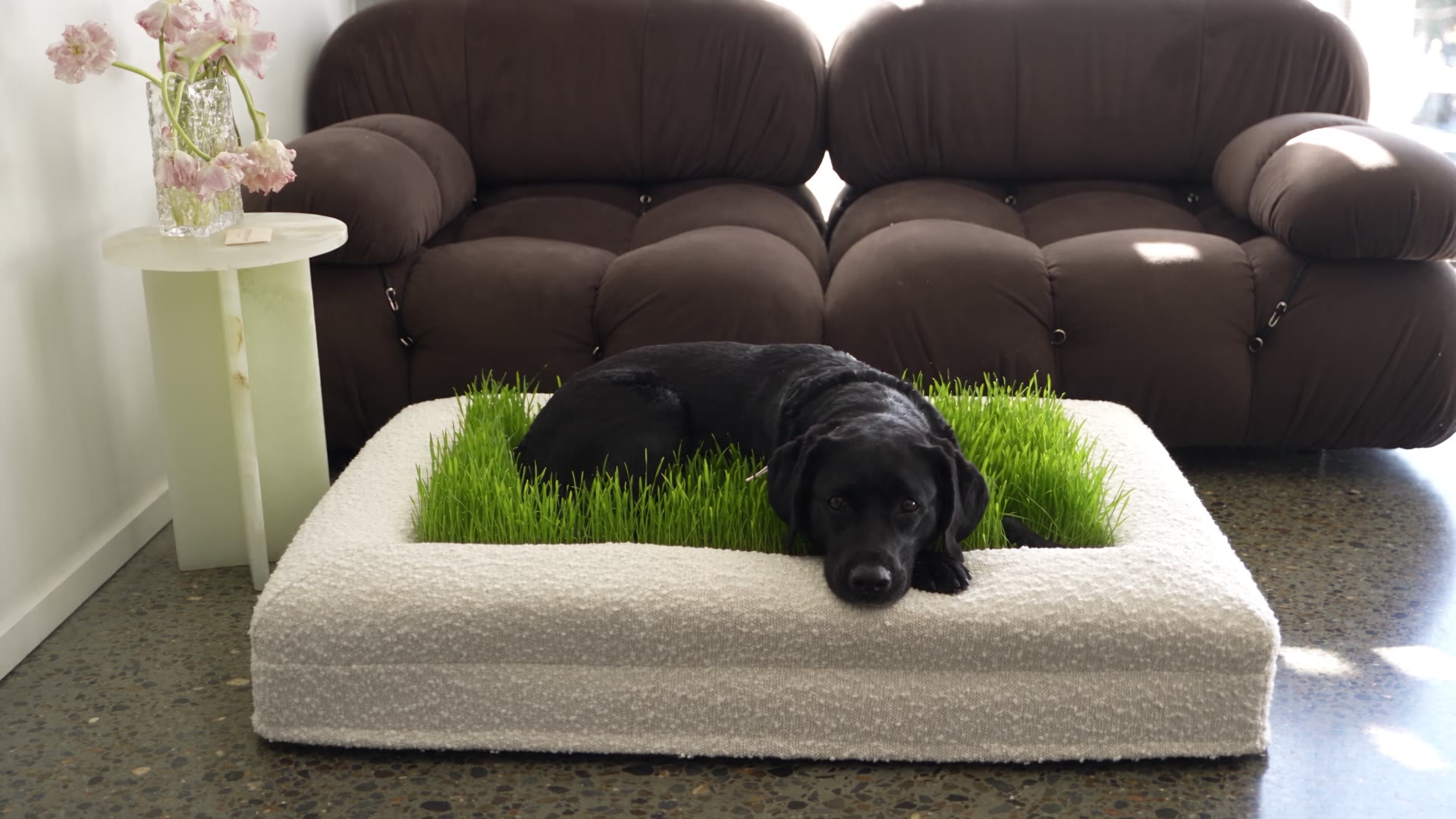
Watch a dog on a warm afternoon and you'll often find them stretched out on the grass, belly to the ground. Cats do the same in a patch of garden soil. For most of history, animals rested in direct contact with the earth. Today, many of our pets spend almost all of their time indoors, on carpet, timber floors and synthetic bedding.
Grounding is the idea of restoring that contact. This guide explains what it is, what the research does and doesn't show, and how to try it with your dog or cat.
What is grounding?
Grounding, also called earthing, means direct physical contact between the body and the earth's surface, such as bare skin on grass, sand or soil. The earth carries a mild natural electrical charge. When a body touches it, the two come to the same electrical potential.
Researchers studying grounding propose that this contact lets the body take up free electrons from the earth, and that these may help balance processes such as inflammation and the stress response. Most of this research has been done in people, with a small but growing body of animal studies.
You don't have to be outdoors to be grounded. Conductive materials connected to the earth through the earth pin of a correctly wired power socket create the same connection indoors. This is how grounding sheets for people work, and it's how a grounding pet bed works.

Why indoor pets miss out
Dogs evolved resting on the ground, and cats seek out warm, quiet spots in the garden when they can. Modern homes separate them from that contact in a few ways:
- Indoor living. Many dogs spend the working day inside, and many cats never go outside at all.
- Insulating surfaces. Carpet, rugs, timber and synthetic bedding don't conduct, so lying on them doesn't connect your pet to the earth.
- Short outdoor time. A daily walk gives some contact through paw pads, but dogs and cats spend 12 or more hours a day resting, almost all of it indoors.
A grounding bed adds contact back during the hours your pet already spends resting, in the spot they choose to sleep.
What does the research say?
It's worth being clear about what we know and what we don't.
In animals. Two recent laboratory studies used earthing mats with rats. In one, stressed rats with an earthing mat showed less anxiety-like behaviour than stressed rats without one, along with lower activity in the brain's stress-hormone pathway (Park et al., 2023). In another, rats on an earthing mat for 21 days spent less time awake and more time in deep and REM sleep (Ye et al., 2024).
In people. Small human studies have reported changes in night-time cortisol and sleep (Ghaly & Teplitz, 2004), lower markers of muscle damage after exercise (Brown, Chevalier & Hill, 2010 and 2015), and improved vagal tone, a marker of nervous-system calm (Passi et al., 2017). A 2015 review discussed how grounding may influence inflammation (Oschman, Chevalier & Brown, 2015).
The honest caveat. Most of these studies are small, and there are not yet published trials of grounding in dogs or cats. Dogs, cats and people share the same core systems for stress, sleep and inflammation, which is why researchers expect similar effects. We look forward to pet-specific trials. Grounding is a wellness practice, not a veterinary treatment.

The Grounding Heart Pet Bed. Orthopaedic comfort with built-in grounding.
Shop the bedHow a grounding pet bed works
The Grounding Heart Pet Bed has a layer of conductive grounding fabric in the sleep surface. A cord connects the bed to the earth pin of a correctly wired wall socket. The bed draws no electricity; the cord connects only to the earthing system of your home.
Because fur insulates, contact happens through the parts of your pet with little or no fur: paw pads, nose and belly. That's why the grounding fabric sits right where your pet lies, under a soft bouclé cover.
How to try grounding with your pet
- Put the bed where they already rest. Dogs and cats have favourite spots. A new bed in their usual place gets used sooner.
- Check your socket. Use a socket tester to confirm the outlet is correctly wired before connecting the cord.
- Keep the cord out of reach. Run it behind furniture or along the skirting so it can't be chewed.
- Give it time. Some pets take to a new bed straight away. Others need a few days.
What to watch for
Allow six to eight weeks and keep an eye on a few everyday things:
- Where your pet chooses to sleep
- How long they take to settle
- Stiffness when getting up after a long rest
- Behaviour when left alone
Every animal is different, and experiences vary. If your pet is unwell or in pain, see your vet.
Frequently asked questions
Is grounding the same as earthing? Yes. The two terms are used interchangeably for direct contact with the earth's surface, or with a conductive surface connected to the earth.
Does my dog get grounded on walks? A little, when their paw pads touch grass, soil or sand. Footpaths, roads and indoor floors don't provide the same connection, and walks are short compared with the time pets spend resting.
Can cats use a grounding bed? Yes. Cats sleep up to 16 hours a day. A round grounding bed placed in a warm, quiet spot they already like suits cats and small dogs well.
Is a grounding bed safe? The bed carries no electrical current. Read our guide, Is a grounding bed safe for pets?, for the full safety checklist.
References
- Park et al. Biomedicines, 2023. Earthing mat and anxiety-like behaviour in stressed rats.
- Ye et al. International Journal of Molecular Sciences, 2024. Earthing mat and sleep architecture in rats.
- Ghaly M, Teplitz D. The biologic effects of grounding the human body during sleep as measured by cortisol levels and subjective reporting of sleep, pain, and stress. Journal of Alternative and Complementary Medicine, 2004.
- Brown D, Chevalier G, Hill M. Pilot study on the effect of grounding on delayed-onset muscle soreness. Journal of Alternative and Complementary Medicine, 2010.
- Brown R, Chevalier G, Hill M. Grounding after moderate eccentric contractions reduces muscle damage. Open Access Journal of Sports Medicine, 2015.
- Oschman JL, Chevalier G, Brown R. The effects of grounding (earthing) on inflammation, the immune response, wound healing, and prevention and treatment of chronic inflammatory and autoimmune diseases. Journal of Inflammation Research, 2015.
- Passi R, et al. Earthing of preterm infants: effect on vagal tone. Neonatology, 2017.